
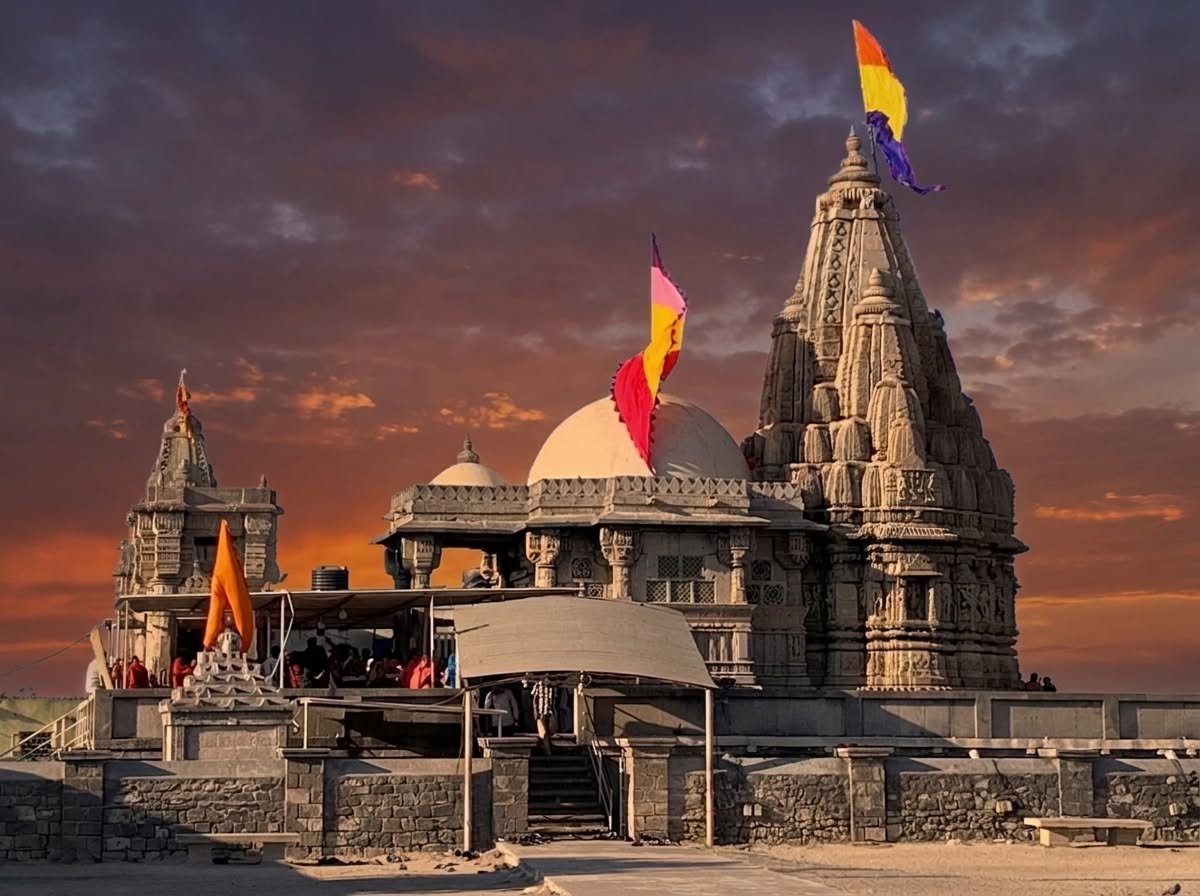
The Rukmini Devi Mandir in Dwarka, Gujarat, is one of the most significant yet often overlooked temples associated with Lord Krishna and Goddess Rukmini. Located about 2 km from the famous Dwarkadhish Temple, this ancient shrine is dedicated exclusively to Goddess Rukmini, the chief queen and divine consort of Lord Krishna.
- Rukmini Devi Temple Tourist Information
- Rukmini Devi Temple Timings
- Why Is the Rukmini Devi Temple Famous?
- History of Rukmini Devi Temple
- The Sacred Geography of Dwarka
- Architecture of Rukmini Devi Temple
- The Sanctum and Idol of Goddess Rukmini
- Ancient Frescoes
- The Legend of Rukmini and Krishna
- The Tulabharam Legend
- Sudama and Rukmini’s Humility
- Marine Archaeology and the Lost City of Dwarka
- The Submergence of Dwarka
- Jal Daan – The Temple’s Most Unique Ritual
- Festivals Celebrated at the Temple
- Madhavpur Ghed Fair – Rukmini’s Wedding Festival
- Swarga Dwar and Moksha Dwar
- Heritage Conservation and ASI Protection
- How to Reach Rukmini Devi Temple
- Best Time to Visit
- Nearby Attractions
- Visitor Tips
- Frequently Asked Questions
Unlike most Krishna temples where Rukmini is worshipped alongside Krishna, this temple stands separately, making it one of the rare standalone temples dedicated to Rukmini Devi in India. According to local tradition, a pilgrimage to Dwarka is considered incomplete without visiting both the Dwarkadhish Temple and the Rukmini Devi Temple.
With its 12th-century Maru-Gurjara architecture, intricate sandstone carvings, ancient frescoes, and powerful mythology, the temple offers a unique blend of spirituality, history, archaeology, and art. Whether you are a pilgrim, architecture enthusiast, photographer, or traveler exploring the Char Dham circuit, the Rukmini Devi Temple is a must-visit attraction in Dwarka.
Rukmini Devi Temple Tourist Information
| Detail | Information |
|---|---|
| Location | Dwarka, Devbhoomi Dwarka district, Gujarat, India |
| Distance from Dwarkadhish Temple | Approx. 2 km |
| Dedicated to | Goddess Rukmini (Lakshmi incarnation) |
| Temple Style | Maru-Gurjara (Solanki) architecture |
| Built | 12th century CE (with later renovations) |
| Entry Fee | Free |
| Photography | Allowed outside; prohibited inside the sanctum |
| Visit Duration | 20–45 minutes |
| Famous Ritual | Jal Daan (water offering) |
| Managed by | Archaeological Survey of India (ASI) |
Rukmini Devi Temple Timings
The temple is open every day of the week.
| Session | Timings |
|---|---|
| Morning Darshan | 6:00 AM – 12:30 PM |
| Evening Darshan | 4:00 PM – 7:30 PM |
- Morning Aarti: Around 9:00 AM
- Evening (Sandhya) Aarti: Around 6:30 PM – 7:00 PM
Timings may vary slightly during festivals and special religious occasions.
Why Is the Rukmini Devi Temple Famous?
The temple is famous for the legend of Sage Durvasa’s curse, which explains why Rukmini and Krishna are worshipped in separate temples in Dwarka.
According to the legend, Lord Krishna and Rukmini invited Sage Durvasa to their palace for a meal. The sage agreed on the condition that the divine couple would personally pull his chariot. During the journey, Rukmini became extremely thirsty. Krishna created a spring of water from the earth, and Rukmini drank from it before offering water to the sage.
Durvasa considered this a breach of hospitality and cursed Rukmini to live separately from Krishna. He also cursed the land of Dwarka with scarcity of sweet water. The Rukmini Devi Temple is believed to mark the place where the goddess resides apart from Krishna, and the region’s historical freshwater scarcity is often linked to this legend.
Because of this story, devotees traditionally visit both temples to complete their pilgrimage and receive the full spiritual merit of their visit.
History of Rukmini Devi Temple
The present structure of the temple is generally attributed to the 12th century CE, during the flourishing period of the Solanki (Chaulukya) dynasty in Gujarat. This was the golden age of Maru-Gurjara temple architecture, known for extraordinary stone carving and architectural precision.
Local traditions, however, connect the site to a much older sacred history. It is believed that the original shrines of Dwarka were established by Vajranabha, the great-grandson of Lord Krishna, more than 2,500 years ago. While archaeology does not confirm this exact date, evidence suggests that the region has witnessed continuous religious activity for millennia.
The temple also reflects later phases of reconstruction. Dwarka suffered repeated destruction and rebuilding during medieval times, particularly after military campaigns in the 15th century CE, and parts of the present structure likely incorporate later renovations from the 15th–19th centuries.
Today, the temple is a protected monument of national importance under the Archaeological Survey of India (ASI).
The Sacred Geography of Dwarka
Dwarka is one of the most sacred cities in Hinduism. It is:
- One of the Char Dham pilgrimage destinations established by Adi Shankaracharya.
- One of the Sapta Puri (seven sacred cities believed to grant liberation).
While the Dwarkadhish Temple represents Krishna as the Lord of the Universe, the Rukmini Devi Temple represents the divine feminine – devotion, grace, prosperity, and unconditional love. The physical distance between the two temples is viewed by devotees as a symbolic reminder of divine separation (viraha) and eternal devotion.
Architecture of Rukmini Devi Temple
The temple is a beautiful example of Maru-Gurjara (Solanki) architecture, one of the most refined temple-building traditions of medieval western India.
Architectural Highlights
- Intricately carved sandstone walls
- Elegant Nagara-style shikhara (spire)
- Decorative floral and geometric patterns
- Sculptures of gods, goddesses, celestial beings, dancers, and musicians
- Ancient fresco paintings
- Ornamental pillars and latticed windows
Although much smaller than the towering Dwarkadhish Temple, the Rukmini Temple is admired for the density and quality of its carvings, which rival some of the finest medieval temples in Gujarat and Rajasthan.
Gajatharas and Naratharas
One of the most distinctive features of the temple is its sculptural program.
Gajatharas (Elephant Friezes)
The lower portions of the temple are decorated with continuous rows of elephants, symbolizing:
- Strength
- Stability
- Royal power
- The cosmic support of the sacred structure
Naratharas (Human Friezes)
Above the elephants are beautifully carved human figures, including:
- Dancers
- Musicians
- Warriors
- Devotees
- Celestial attendants
These carvings provide a fascinating glimpse into medieval Gujarati society and artistic traditions.
A Unique Architectural Blend
The temple exhibits an interesting architectural combination. While the sanctum is crowned with a traditional Nagara-style curvilinear shikhara, the adjoining mandapa (assembly hall) features a distinctive domed roof and square latticed openings. Scholars often interpret this as evidence of later rebuilding and architectural adaptation over several centuries.
The Sanctum and Idol of Goddess Rukmini
The garbha griha (sanctum sanctorum) houses a graceful marble idol of Goddess Rukmini.
She is depicted standing with four arms, holding:
- Shankha (conch)
- Chakra (discus)
- Gada (mace)
- Padma (lotus)
This iconography identifies her not only as Krishna’s queen but also as a manifestation of Goddess Lakshmi, the goddess of prosperity and divine grace.
The idol is traditionally adorned with gold ornaments, silk garments, and fresh flower garlands.
Ancient Frescoes
The temple preserves remnants of 12th-century fresco paintings, among the rare surviving examples of medieval Gujarati mural art.
These paintings once illustrated episodes from the lives of Krishna and Rukmini, using natural mineral pigments such as:
- Ochre
- Vermilion
- Indigo
Although weathered by centuries of coastal humidity and salt-laden air, the frescoes remain an important artistic and historical treasure.
The Legend of Rukmini and Krishna
Rukmini Haran (The Divine Elopement)
Rukmini was born to King Bhishmaka, ruler of the kingdom of Vidarbha. Having heard of Krishna’s virtues and divine nature, she fell deeply in love with him.
Her brother Rukmi, however, opposed the marriage and arranged her wedding with Shishupala, a rival king.
In desperation, Rukmini secretly sent a letter to Krishna, declaring her devotion and requesting that he rescue her before the wedding.
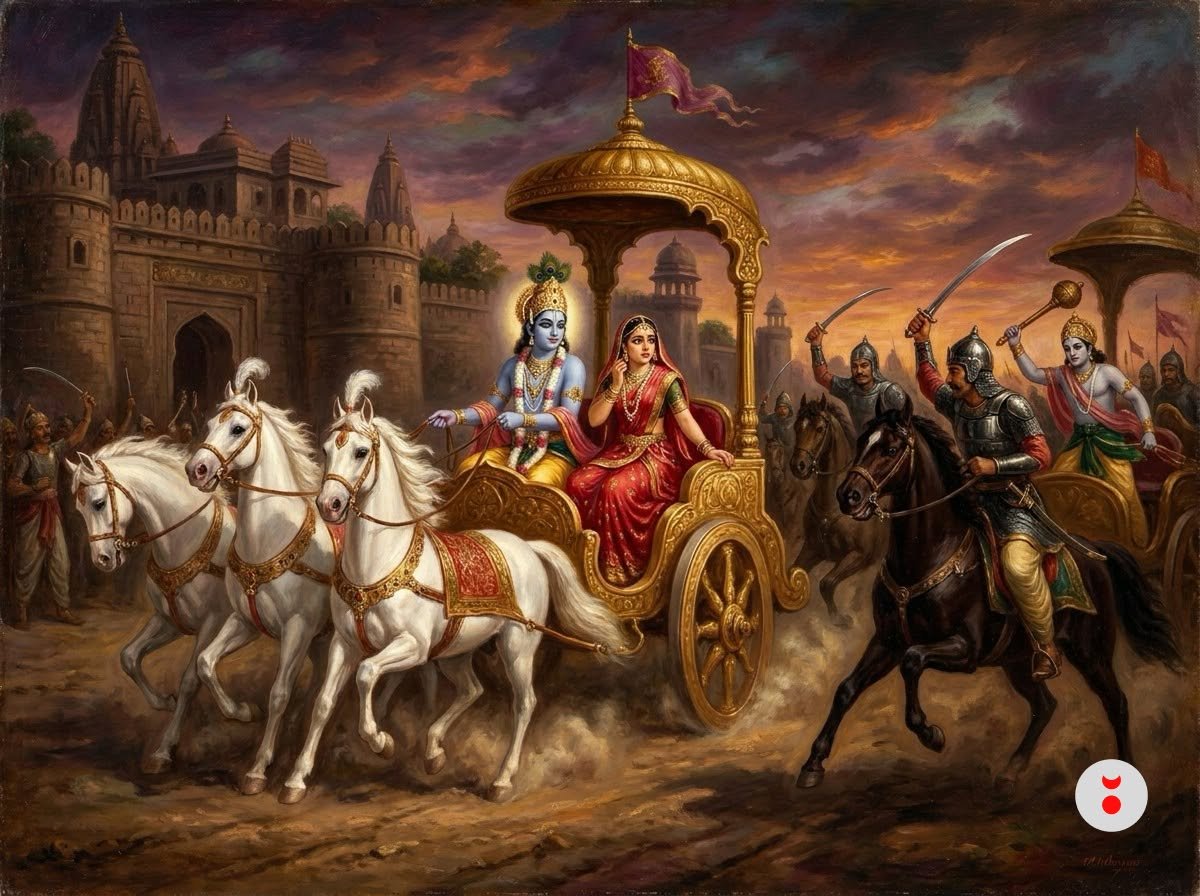
Krishna arrived in Vidarbha, abducted Rukmini from the temple of Goddess Ambika, defeated the pursuing armies, and brought her to Dwarka, where they were married.
This dramatic episode, known as Rukmini Haran, is one of the most celebrated love stories in Hindu mythology.
The Tulabharam Legend
Another famous legend highlights Rukmini’s devotion.
According to the Tulabharam story, Krishna was placed on one side of a balance scale while enormous quantities of gold and jewels were placed on the other. Despite immense wealth, the scale would not balance.
Rukmini then placed a single Tulsi (holy basil) leaf on the scale with pure devotion.
Instantly, the balance was achieved, symbolizing that true devotion outweighs all material wealth.
Sudama and Rukmini’s Humility
The Puranic traditions also describe how Rukmini personally welcomed Sudama, Krishna’s impoverished childhood friend.
She served him food and attended to him with humility and affection, illustrating her compassion and ideal queenly virtues.
Marine Archaeology and the Lost City of Dwarka
The significance of the Rukmini Devi Temple extends beyond mythology into the realm of archaeology.
Since 1979, extensive underwater investigations by the Archaeological Survey of India (ASI) and marine archaeologist Dr. S. R. Rao have uncovered:
- Submerged stone structures
- Ancient jetties
- Fortified walls
- Bastions
- Stone anchors
- Pottery associated with ancient maritime settlements
Many of these remains have been dated to 3,500–5,000 years before present, suggesting that the coast around modern Dwarka has been inhabited since remote antiquity.
While archaeology does not prove every element of the Krishna legend, the discoveries have made Dwarka one of India’s most fascinating intersections of mythology and scientific research.
The Submergence of Dwarka
According to the Mahabharata (Mausala Parva), the Yadu dynasty eventually destroyed itself in a tragic civil conflict.
After Krishna departed from the earthly world, the Arabian Sea reclaimed the city of Dwarka, submerging its magnificent palaces beneath the waves.
The underwater archaeological discoveries near modern Dwarka are often viewed by pilgrims as a powerful echo of this ancient tradition.
Jal Daan – The Temple’s Most Unique Ritual
The defining ritual of the Rukmini Devi Temple is Jal Daan (water donation).
Because Rukmini’s separation is linked to her moment of thirst, devotees offer drinking water to the goddess.
Unlike many temples where sweets or flowers are the primary offerings, water is the most sacred offering here.
Participating in Jal Daan is believed to bring:
- Spiritual merit
- Prosperity
- Relief from hardships
- Blessings of Goddess Lakshmi
A small voluntary donation is usually accepted for this ritual.
Festivals Celebrated at the Temple
The temple becomes especially vibrant during several Vaishnava festivals.
Rukmini Ashtami
The most important festival dedicated specifically to Goddess Rukmini.
Celebrations include:
- Special pujas
- Floral decorations
- Processions
- Devotional music
- Extended darshan hours
Other Major Festivals
- Janmashtami
- Holi
- Tulsi Vivah
- Purushottam Maas observances
- Dwadashi rituals
Madhavpur Ghed Fair – Rukmini’s Wedding Festival
One of the most remarkable cultural traditions associated with Rukmini is the Madhavpur Ghed Fair held in Porbandar district, Gujarat.
The festival commemorates the marriage of Krishna and Rukmini and celebrates the ancient cultural connection between Gujarat and Arunachal Pradesh.
According to regional traditions, Rukmini’s ancestral kingdom is linked to Bhismaknagar in Arunachal Pradesh, and the fair symbolically reenacts her journey from the northeast of India to the western coast of Gujarat.
Today, the festival features:
- Garba and Raas
- Northeastern tribal dances
- Folk music
- Cultural exhibitions
- Handicrafts
- Traditional food festivals
It has become an important celebration of national integration and shared cultural heritage.
Swarga Dwar and Moksha Dwar
Although located at the Dwarkadhish Temple, these gateways form an important part of the broader pilgrimage experience connected with the Rukmini Temple.
Swarga Dwar (Gate of Heaven)
- Main entrance to the Dwarkadhish Temple
- Reached by climbing 56 sacred steps
- Symbolizes the ascent toward divine grace
Moksha Dwar (Gate of Liberation)
- Exit gate of the temple complex
- Symbolizes liberation and spiritual completion
Pilgrims often visit the Dwarkadhish Temple first, followed by the Rukmini Devi Temple, thereby completing the sacred journey from divine union to divine devotion.
Heritage Conservation and ASI Protection
The temple is officially protected by the Archaeological Survey of India (ASI) as a Monument of National Importance.
Conservation efforts focus on:
- Protecting intricate stone carvings
- Preserving medieval frescoes
- Stabilizing structural elements
- Managing damage caused by:
- Salt-laden coastal air
- Humidity
- Monsoons
- Cyclonic weather
The temple remains one of the finest surviving examples of medieval Gujarati temple architecture.
How to Reach Rukmini Devi Temple
From Dwarkadhish Temple
- Distance: 2–2.5 km
- Auto-rickshaw: 5–10 minutes
- Fare: ₹30–₹70 (approx.)
Many visitors combine the temple with Nageshwar Jyotirlinga and nearby attractions.
By Train
- Nearest Railway Station: Dwarka Railway Station
- Distance: About 2 km
Dwarka is connected to Rajkot, Ahmedabad, Jamnagar, and other major cities of Gujarat.
By Air
- Nearest Airport: Rajkot International Airport
- Distance: Approximately 225 km
By Road
Dwarka is well connected through National Highway 27 (NH27).
Rajkot to Dwarka
| Segment | Distance | Travel Time |
|---|---|---|
| Rajkot → Jamnagar | ~74 km | 1–1.5 hrs |
| Jamnagar → Dwarka | ~141 km | 2.5–3 hrs |
| Total | 215–236 km | 3.5–5 hrs |
Bus, taxi, and private vehicle options are widely available.
Best Time to Visit
The ideal time to visit is October to March, when the weather is pleasant for temple visits and sightseeing.
Seasonal Guide
| Season | Recommendation |
|---|---|
| Winter (Oct–Mar) | Best time to visit |
| Summer (Apr–Jun) | Hot but manageable in early morning/evening |
| Monsoon (Jul–Sep) | Scenic but occasionally humid |
Early morning and sunset visits offer the most peaceful atmosphere and the best lighting for photography of the temple exterior.
Nearby Attractions
After visiting Rukmini Devi Temple, you can explore:
- Dwarkadhish Temple (Jagat Mandir) – 2 km
- Gomti Ghat
- Sudama Setu
- Nageshwar Jyotirlinga
- Bet Dwarka
- Bhadkeshwar Mahadev Temple
- Shivrajpur Beach
- Bet Dwarka Bethakji
- ISKCON Temple, Dwarka
Visitor Tips
- Wear modest and traditional clothing.
- Remove footwear before entering the temple.
- Photography is allowed in the outer premises only.
- The temple remains closed during the afternoon.
- Carry drinking water during summer months.
- Participate in Jal Daan for a unique local spiritual experience.
- Combine your visit with the Dwarkadhish Temple for a complete pilgrimage.
Frequently Asked Questions
Is Rukmini Devi Temple worth visiting?
Yes. Rukmini Devi Temple is one of the most important pilgrimage and heritage sites in Dwarka. It is famous for its connection with Lord Krishna and Goddess Rukmini, exquisite 12th-century stone carvings, ancient frescoes, and the unique Jal Daan (water offering) ritual. Most visitors consider it an essential stop along with the Dwarkadhish Temple.
Why is Rukmini Devi Temple separate from Dwarkadhish Temple?
According to Hindu mythology, Sage Durvasa cursed Rukmini Devi to live separately from Lord Krishna after she drank water before offering it to him. As a result, the Rukmini Devi Temple was established about 2 km away from the Dwarkadhish Temple, symbolizing the divine separation of the couple.
What are the timings of Rukmini Devi Temple in Dwarka?
The temple is generally open daily from 6:00 AM to 12:30 PM and from 4:00 PM to 7:30 PM. Morning and evening aarti timings may vary slightly during festivals.
Is there any entry fee for Rukmini Devi Temple?
No. Entry to Rukmini Devi Temple is completely free for all visitors and devotees.
How much time is needed to visit Rukmini Devi Temple?
A typical visit takes 20–45 minutes, including darshan, observing the carvings, and participating in the Jal Daan ritual.
Can I visit Rukmini Devi Temple before Dwarkadhish Temple?
Yes, but most pilgrims traditionally visit Dwarkadhish Temple first and then Rukmini Devi Temple. According to local belief, visiting both temples completes the spiritual journey in Dwarka.
What is the distance between Rukmini Devi Temple and Dwarkadhish Temple?
The distance is approximately 2 km. An auto-rickshaw ride usually takes 5–10 minutes.
Is photography allowed inside Rukmini Devi Temple?
Photography is generally allowed in the outer temple premises, where the intricate carvings can be photographed. However, photography inside the sanctum (garbha griha) is prohibited.
What is the famous offering at Rukmini Devi Temple?
The temple is famous for Jal Daan (water donation). Devotees offer drinking water to Goddess Rukmini in remembrance of the legendary episode of her thirst during Sage Durvasa’s journey.
Which architectural style does the temple follow?
Rukmini Devi Temple is a classic example of Maru-Gurjara (Solanki) architecture, known for its richly carved sandstone walls, decorative sculptures, and elegant temple spire.
How old is Rukmini Devi Temple?
The present structure is generally believed to have been built in the 12th century CE, although the site itself is associated with much older traditions connected to ancient Dwarka.
Who built Rukmini Devi Temple?
Historians attribute the existing temple largely to the Solanki dynasty, while local traditions associate the original shrine with Vajranabha, the great-grandson of Lord Krishna.
What is the best time to visit Rukmini Devi Temple?
The best time to visit is October to March, when Dwarka experiences pleasant weather. Early morning and evening visits are especially recommended for a peaceful experience.
Is Rukmini Devi Temple part of the Char Dham Yatra?
The temple itself is not one of the four Char Dham temples, but it is located in Dwarka, which is one of the Char Dham pilgrimage destinations. Pilgrims visiting Dwarka usually include Rukmini Devi Temple in their itinerary.
Is Rukmini Devi considered Goddess Lakshmi?
Yes. In Hindu tradition, Goddess Rukmini is regarded as an incarnation of Goddess Lakshmi, the goddess of wealth, prosperity, and divine grace.
Are there any dress code rules for Rukmini Devi Temple?
There is no strict dress code, but visitors are expected to wear modest and respectful clothing suitable for a place of worship.
Is the temple managed by the Archaeological Survey of India (ASI)?
Yes. Rukmini Devi Temple is a protected monument of national importance under the Archaeological Survey of India (ASI).
Conclusion
The Rukmini Devi Temple of Dwarka is far more than a small shrine on the outskirts of the city. It is a remarkable monument where mythology, medieval architecture, archaeology, devotion, and cultural history converge.
From the moving legend of Rukmini’s separation from Krishna and the unique Jal Daan ritual to the exquisite Maru-Gurjara carvings, ancient frescoes, and archaeological legacy of submerged Dwarka, the temple offers a deeply enriching experience that appeals to pilgrims, historians, artists, and travelers alike.
If you are visiting Dwarka, Gujarat, make sure to include the Rukmini Devi Temple in your itinerary. It is one of the rare places where a short visit can reveal thousands of years of faith, history, and artistic heritage in a single sacred space.