

Dwarka’s Sacred Confluence Where the River Meets Sea In the Shadow of Krishna
About Gomti Ghat – Dwarka in Hindu Mythology, History, and Ritual Practice
- Dwarka’s Sacred Confluence Where the River Meets Sea In the Shadow of Krishna
- Geographic and Theological Context
- Mythological Foundations and the Krishna Narrative
- Historical Antiquity, Marine Archaeology, and Coastal Shifts
- The Sacred Geography of Gomti Ghat
- Ritual Architecture and Observances at Gomti Ghat
- Annual Festivals and Temporal Rhythms
- The Gomti Chakra: Biological Reality, Astrological Symbolism, and Commerce
- Looking back on the horizon
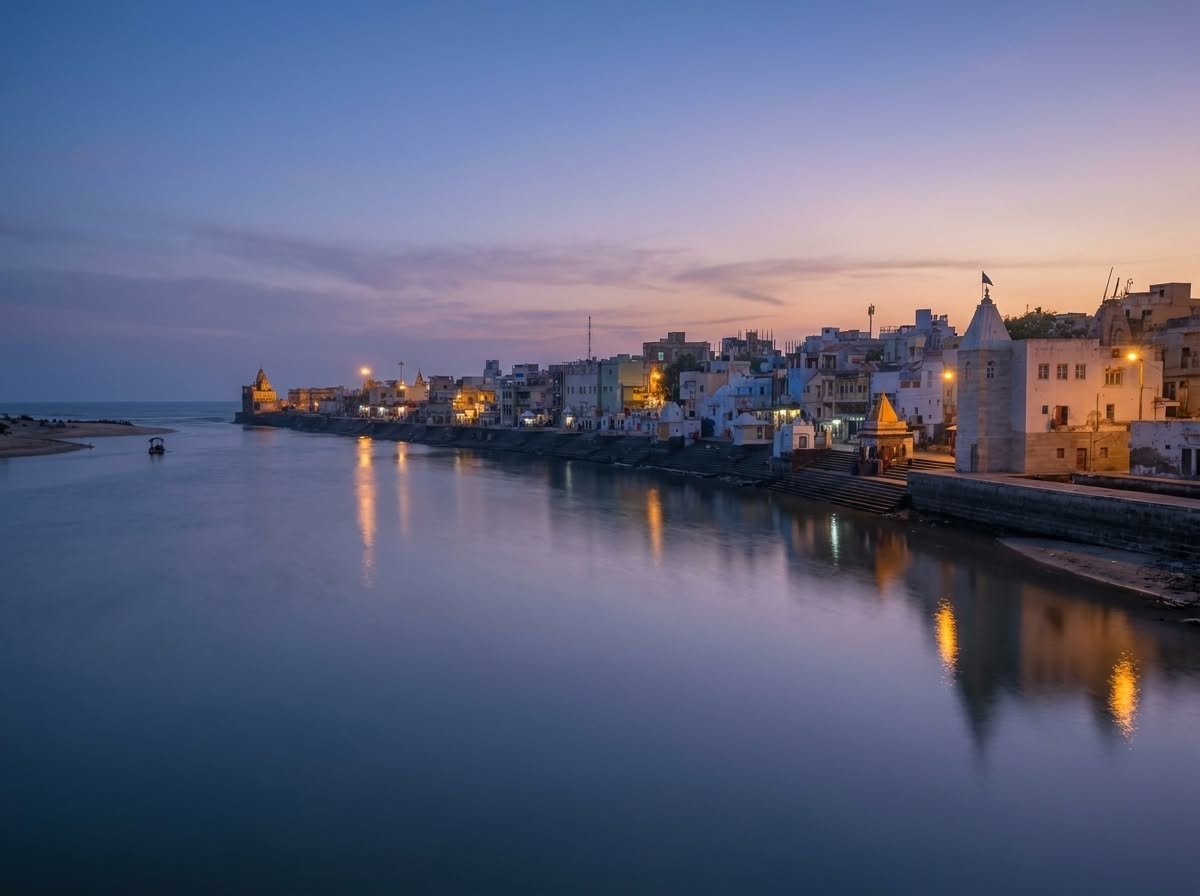
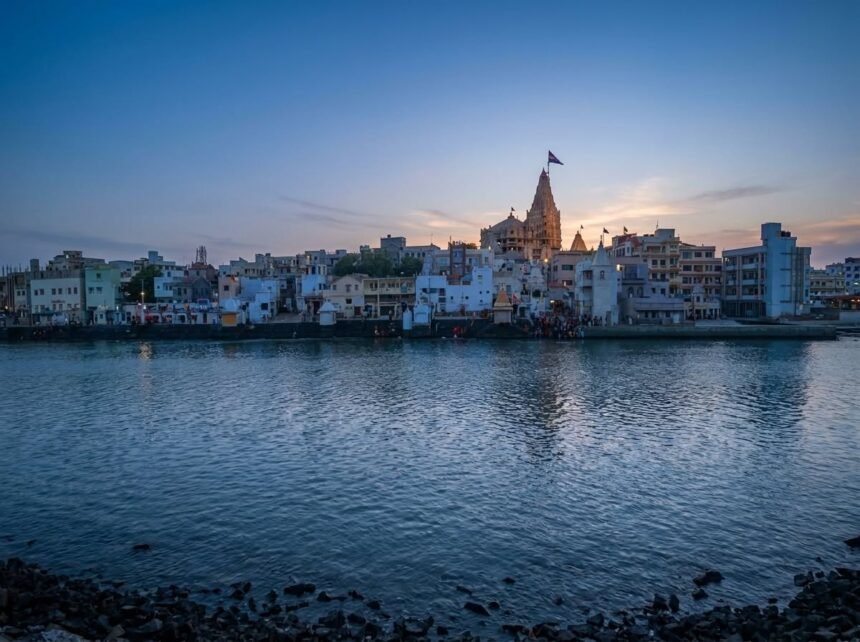
The ancient coastal city of Dwarka, situated on the western shore of the Okhamandal Peninsula in Gujarat, India, occupies a paramount position in the sacred geography and historical consciousness of the Indian subcontinent. Positioned strategically at the mouth of the Gulf of Kutch, where the Gomti River empties into the expanse of the Arabian Sea, the city serves as a profound intersection of hydrology, theology, and historical antiquity. The name “Dwarka,” derived from the Sanskrit word dvara (meaning door or gate) and the suffix ka (representing Brahma), translates to the “gateway to heaven” or “gateway to liberation”. Among its most spiritually potent and ritually active precincts is Gomti Ghat, a meticulously engineered series of stone-stepped embankments that border the tidal Gomti River. This report provides a comprehensive examination of Gomti Ghat and the wider Dwarka ecosystem, analyzing its geographical context, its complex historical and archaeological evolution, the mythological frameworks that define its structural layout, the intricate ritual architecture embedded in its 56 sacred kunds, its function as a primary theater for ancestral veneration (Pind Daan), and the biological and spiritual significance of the Gomti Chakra harvested from its waters.
Geographic and Theological Context
Dwarka stands as one of the Char Dham the four cardinal pilgrimage sites of Hinduism established by the philosopher-saint Adi Shankaracharya in the 8th century CE. Alongside Badrinath in the north, Puri in the east, and Rameswaram in the south, Dwarka forms a sacred grid that physically and spiritually maps the boundaries of traditional Hindu practice. Concurrently, it is recognized as one of the Sapta Puri the seven most ancient and holy cities capable of granting moksha (liberation from the cycle of rebirth).
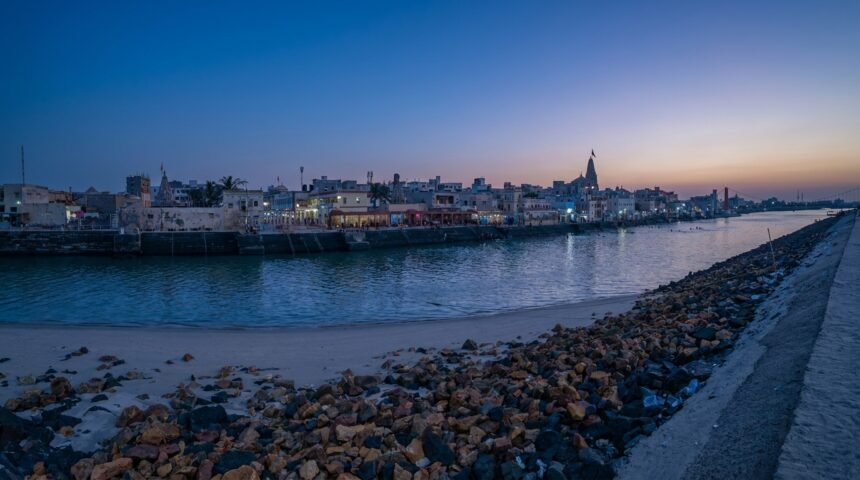
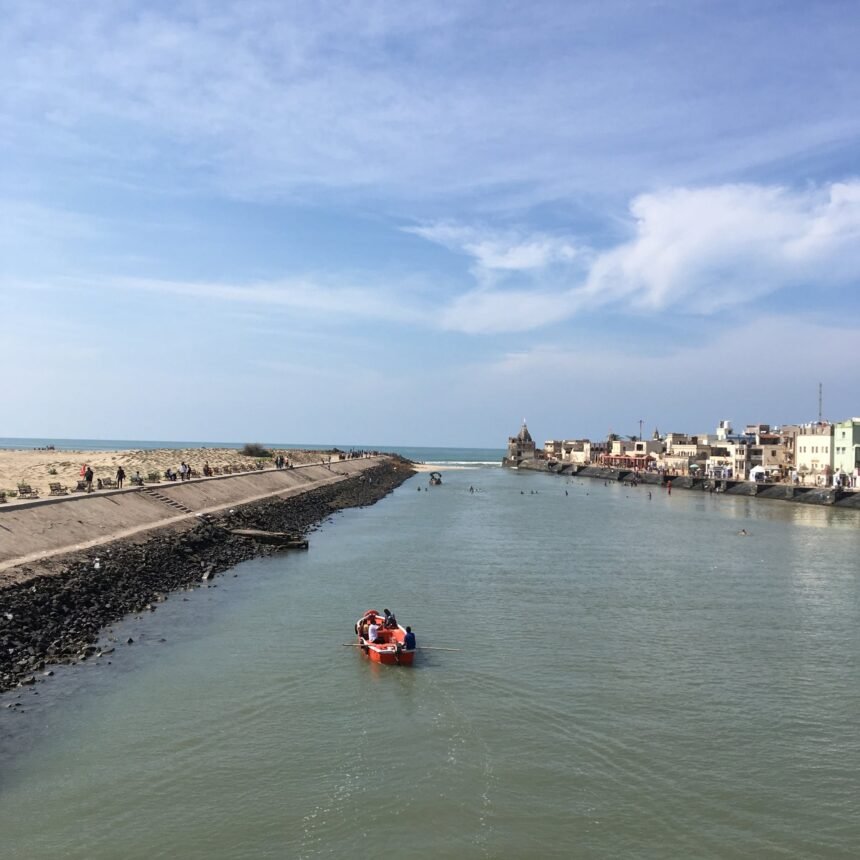
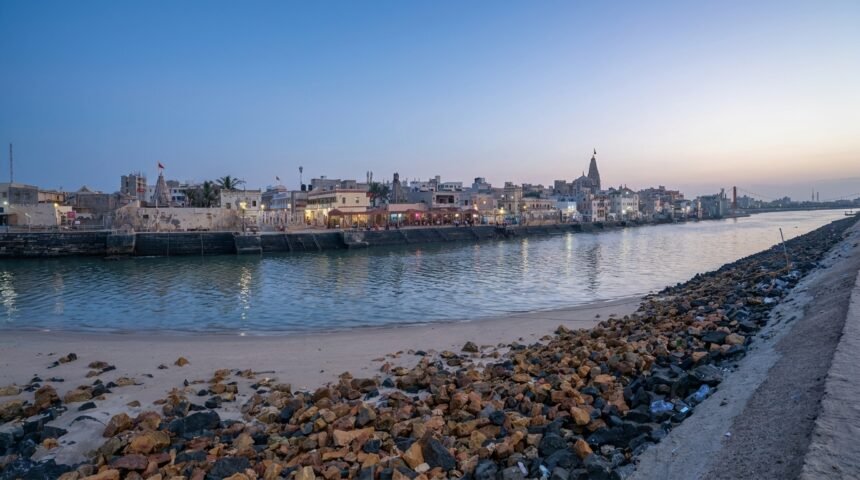
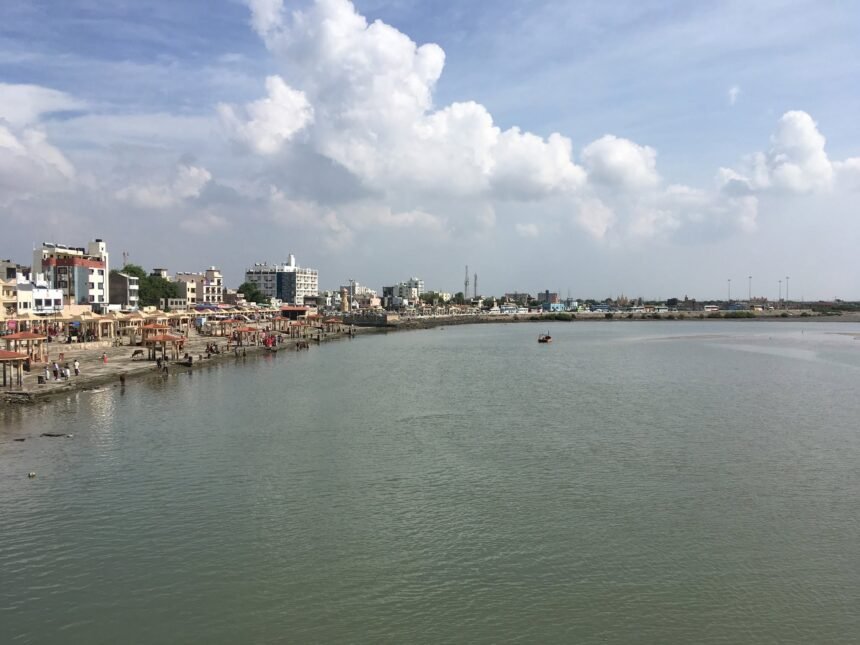
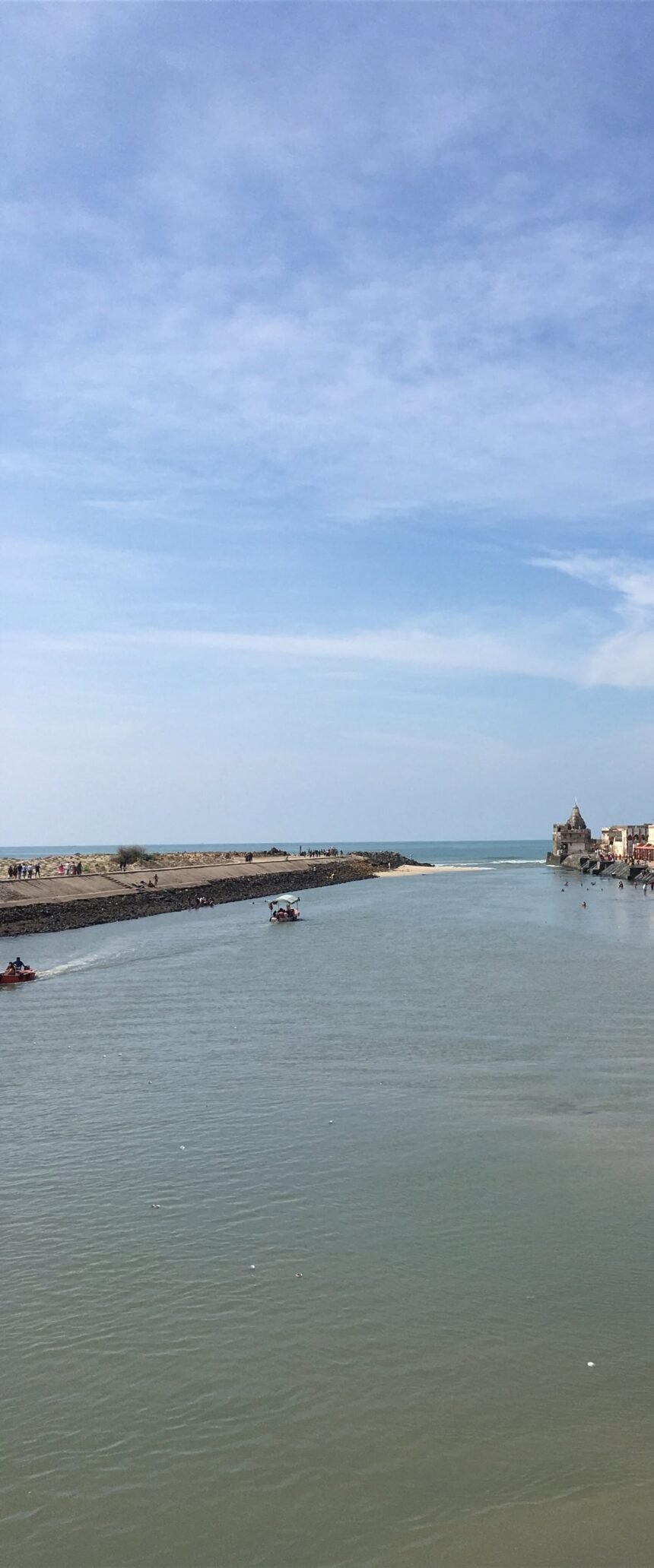
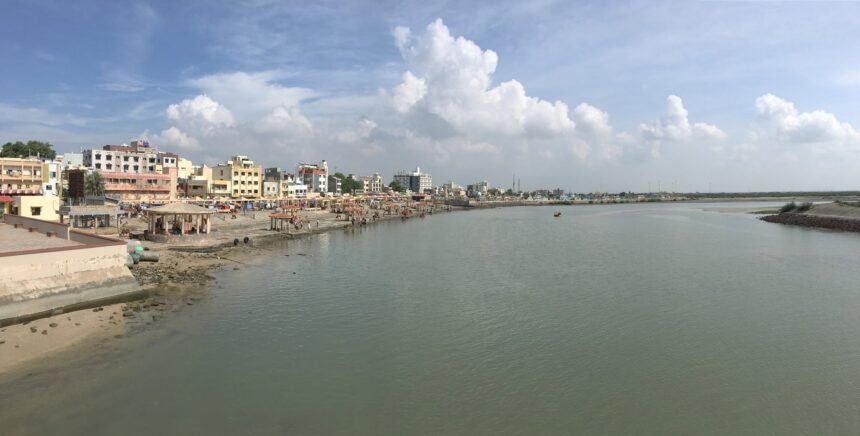
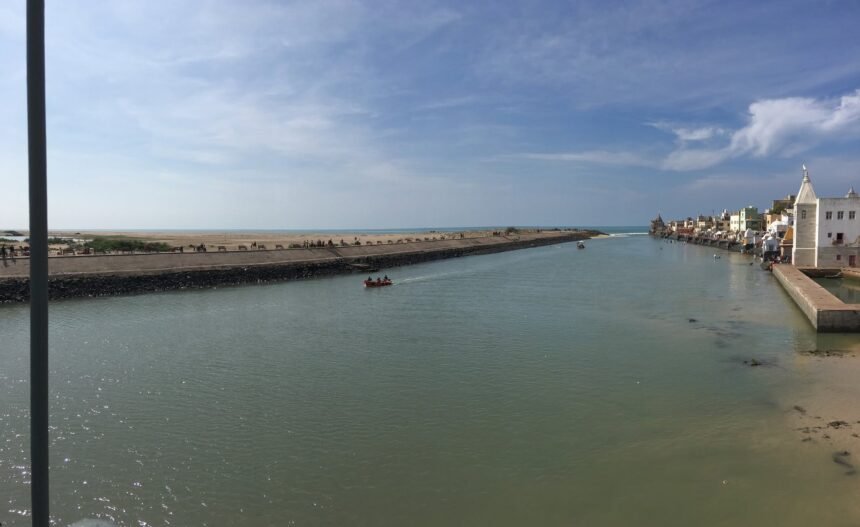
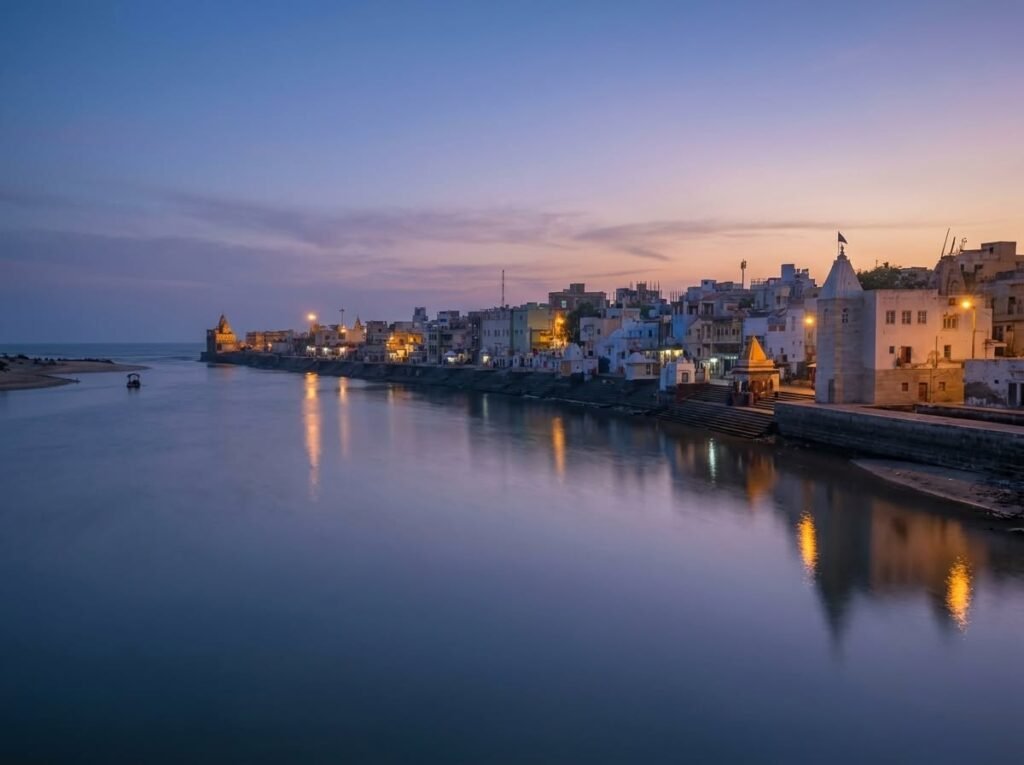
The geographic anchor of this spiritual capital is the Gomti River. Unlike the massive, perennial Himalayan rivers of northern India, the Gomti of Dwarka is a localized tidal waterway that originates near the village of Bhavda at a site known as Mul-Gomti, flowing approximately 10 kilometers before meeting the Arabian Sea at Gomti Ghat. Because the river is tidal, rising and falling with the oceanic rhythms of the Arabian Sea, it is perceived not merely as a terrestrial river but as a living extension of Samudra (the ocean god) breathing life into the sacred channel twice daily. This confluence, or Sangam, establishes Gomti Ghat as a highly charged spiritual threshold, equal in theological weight to the River Ganges for pilgrims seeking purification.
The journey to this remote western outpost has been a historical pilgrimage route for millennia. Today, modern infrastructure facilitates this transit, yet the geographical distances remain a testament to the isolation of the Kathiawar peninsula. Travelers and pilgrims navigating the regional network typically base their approach from major hubs like Rajkot.
| Route segment | Approximate Distance | Travel Time (Road) | Infrastructure and Context |
| Rajkot to Dwarka | 225 – 230 km | 4.5 to 5.5 hours | Traverses NH27 and NH151 via Jamnagar and Khambhaliya. Represents the primary modern pilgrim corridor into the Okhamandal peninsula. |
| Dwarka to Somnath | 230 – 250 km | 5.5 to 6 hours | Connects the Vaishnava capital to the prime Shaivite Jyotirlinga, passing coastal villages and Porbandar. |
| Dwarka to Bet Dwarka | 30 – 36 km + Ferry | 1 hour | Connects the mainland temple to the island residence of Krishna, crossing the Gulf of Kutch. |
Mythological Foundations and the Krishna Narrative
The spiritual magnetism of Gomti Ghat cannot be decoupled from its mythological genesis. The Puranas and the Mahabharata provide rich allegorical frameworks that continue to govern the ritual behavior of millions of pilgrims, physically mapping epic narratives onto the coastal topography.
The Descent of the Gomti and the City of Gold
In Hindu cosmology, the Gomti River at Dwarka is revered as the “descending Ganga.” According to local legend, Sage Vashishta summoned his divine daughter, Goddess Gomti, from the heavens to the earth to purify Lord Rama following his battle with the demon king Ravana. After facilitating this cosmic purification, the Goddess Gomti continued to flow across the land, eventually merging into the Arabian Sea.
It was on the highly auspicious banks of this confluence that Lord Krishna, seeking a secure and pristine environment for his people, chose to build his empire. According to the Mahabharata, Krishna and his Yadava clan migrated from Mathura to escape the relentless, harassing raids of the tyrant Jarasandha, the king of Magadha. Arriving at the coast of Saurashtra, Krishna invoked Samudra, the god of the ocean, requesting a grant of 12 yojanas (approximately 96 square kilometers) of land. With the land secured, the divine craftsman Vishwakarma was commissioned to construct the capital in a mere two days. The resulting metropolis was known as Suvarna Dwarka (the city of gold), described in scriptures as boasting 900,000 royal palaces constructed with crystal, silver, and emeralds, surrounded by deep defensive moats.
The Curse of Sage Durvasa
The geography of Dwarka’s temples is intrinsically linked to a narrative involving Sage Durvasa, an ascetic renowned for his immense spiritual power and volatile temper. Scriptures dictate that Krishna and his chief consort, Queen Rukmini, invited the sage to dine at their palace. Durvasa agreed on the strict condition that the divine couple personally pull his chariot, acting as draft animals to demonstrate their humility. During the arduous journey, Rukmini became intensely thirsty. To quench her thirst without halting their progress, Krishna pressed his toe into the earth, drawing forth the sacred waters of the Ganges/Gomti. Rukmini drank the water without first offering a portion to their guest.
Enraged by this breach of hospitality and protocol, Durvasa cursed Rukmini to live separated from her husband for twelve years. This mythological schism is physically manifested in Dwarka’s modern geography. The Rukmini Devi Temple, a 12th-century architectural masterpiece renowned for its intricate carvings, stands in arid isolation approximately two kilometers away from the main Dwarkadhish Temple and Gomti Ghat. To this day, the temple perpetuates the custom of Jal Daan (donating drinking water), serving as a perpetual penance for Rukmini’s mythological thirst, reflecting a landscape where water is both a purifying agent and a source of ancient consequence.
The Submergence and the 56 Koti Yadavas
The golden era of Dwarka ended in cataclysm. Following the catastrophic Kurukshetra War, the Yadava clan fell into internal conflict and destroyed itself in a fratricidal battle at Prabhasa, fulfilling a curse laid upon them by wandering sages. Krishna himself withdrew from the world shortly thereafter. Following his departure from his mortal body, the ocean rose and reclaimed the 12 yojanas of land, submerging the golden city entirely and ushering in the Kali Yuga.
The memory of the fallen Yadavas is structurally embedded into the architecture connecting the Dwarkadhish Temple to Gomti Ghat. The temple complex features two primary gateways: the Moksha Dwar (Door of Salvation) to the north, acting as the main entrance, and the Swarg Dwar (Door of Heaven) to the south. Descending from the Swarg Dwar to the waters of the Gomti Ghat is a grand, sweeping staircase comprising exactly 56 steps. Oral traditions and scriptural interpretations assert that these 56 steps symbolize the 56 Koti (crores) of Yadavas who comprised Krishna’s extended clan. Thus, the physical act of descending the steps to the river is transformed into a ritual of somatic memory, a physical acknowledgment of the fallen lineage of the divine avatar.
Historical Antiquity, Marine Archaeology, and Coastal Shifts
The history of Dwarka and the Gomti riverfront represents a complex layering of scriptural tradition, cycles of violent structural destruction and reconstruction, and modern marine archaeology. Over the past century, archaeological investigations have increasingly validated the presence of a massive, ancient coastal civilization in the exact location described by the epics.
Submerged Settlements and Tectonic Instability
Extensive archaeological investigations conducted both onshore and offshore in the Arabian Sea have transformed Dwarka from a purely mythological construct into a subject of rigorous scientific inquiry. Excavations initiated by the Archaeological Survey of India (ASI) in the mid-to-late 20th century revealed submerged settlements, substantial stone-built jetties, and distinct triangular stone anchors featuring three holes, indicating a highly developed maritime port that flourished during the Middle Kingdoms of India.
The discovery of underwater structural masonry, including dressed sandstone fortification walls and bastions, aligns with late Harappan and early Vedic architectural techniques. Carbon dating of organic materials associated with these structures places the ruins between 3,500 and 5,000 years old. Geological and oceanographic analyses suggest that the western coastline of the Saurashtra-Kutch region has remained highly tectonically active since the late Quaternary period. Subsidence, vertical crustal movements, and Holocene sea-level oscillations are believed to be the primary drivers of the ancient city’s submersion.
This pattern of coastal submersion is not unique to Dwarka but is evident across the Saurashtra coast. Approximately 45 kilometers away lies the Pindara Group of Temples, a site of immense historical and religious significance associated with Sage Durvasa and the Pandavas. The onshore Pindara temples date to the pre-Caulukyan Maitraka-Saindhava period (7th to 10th centuries CE) and exhibit Phamsana and Nagara architectural styles. However, offshore explorations at Pindara in 2007 uncovered an entire submerged temple complex in the intertidal zone, including remnants of plinths and a Shivalinga yoni. These findings strongly correlate with the submergence narrative of Dwarka, pointing to localized tectonic instability, shoreline advancement, and seismic activity over the last millennium that swallowed early medieval religious infrastructure.
Cycles of Destruction and Restoration
The architectural heritage surrounding Gomti Ghat has endured immense historical volatility. The original Dwarkadhish Temple (Jagat Mandir), the epicenter of the town’s religious life, was purportedly established by Vajranabha, Krishna’s great-grandson, directly over the hari-griha (Krishna’s residential palace). Archaeological stratigraphy confirms multiple building phases; onshore excavations near the current temple have yielded settlements from the 1st century BCE, with the earliest identifiable temple structure dating to approximately 200 BCE.
The sacred precinct faced severe devastation during the medieval period. In 1241 CE, an invasion by Muhammad Shah brought localized destruction, during which five Brahmin males fought to defend the temple and were martyred. A more catastrophic event occurred in 1472-1473 CE, when the Gujarat Sultan Mahmud Begada sacked Dwarka, systematically destroying the temple and the surrounding ghat infrastructure.
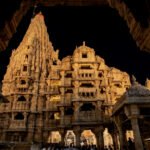
Subsequent centuries saw the Jagat Mandir rebuilt and massively expanded. The current soaring structure, characterized by its 78.3-meter high Shikhara and the 72-pillared Ladwa Mandap assembly hall, reflects Solanki-style architecture predominantly dating to the 15th and 16th centuries. Further damage occurred much later, during the Indian Rebellion of 1857-1858. British forces, engaging the local Vagher insurgents who had captured Okhamandal, bombed the Dwarka and Bet Dwarka temples under the command of Colonel Donovan. Widespread outrage among the regional populations of Jamnagar and Porbandar led to extensive restorations in 1861 funded by Maharaja Khanderao Gaekwad of Baroda and the British administration. The Gaekwad dynasty’s patronage continued into the 20th century, with the installation of a golden pinnacle on the Shikhara in 1958.
| Historical Era | Key Architectural and Geopolitical Developments |
| 3500 – 5000 BP | Establishment of advanced coastal settlements; offshore anchors and fortified walls indicate an active, flourishing port city. |
| 400 BCE – 200 BCE | Earliest construction phases of the original Dwarkadhish Temple (Jagat Mandir) initiated by Vajranabha. |
| 7th – 10th Century CE | Maitraka and Saindhava dynasties construct the Pindara Group of Temples and early Dwarka shrines. Adi Shankaracharya visits, integrating Dwarka into the Char Dham. |
| 1472 – 1473 CE | Sultan Mahmud Begada invades and destroys the Dwarkadhish Temple. Subsequent rebuilding occurs in the 15th-16th centuries. |
| 1858 – 1861 CE | British forces heavily damage temples during the Vagher uprising. Renovations are sponsored by Maharaja Khanderao Gaekwad of Baroda. |
| Late 20th Century | Marine archaeological surveys by ASI confirm the existence of a submerged port city matching the geographic descriptions of the Mahabharata epics. |
The Sacred Geography of Gomti Ghat
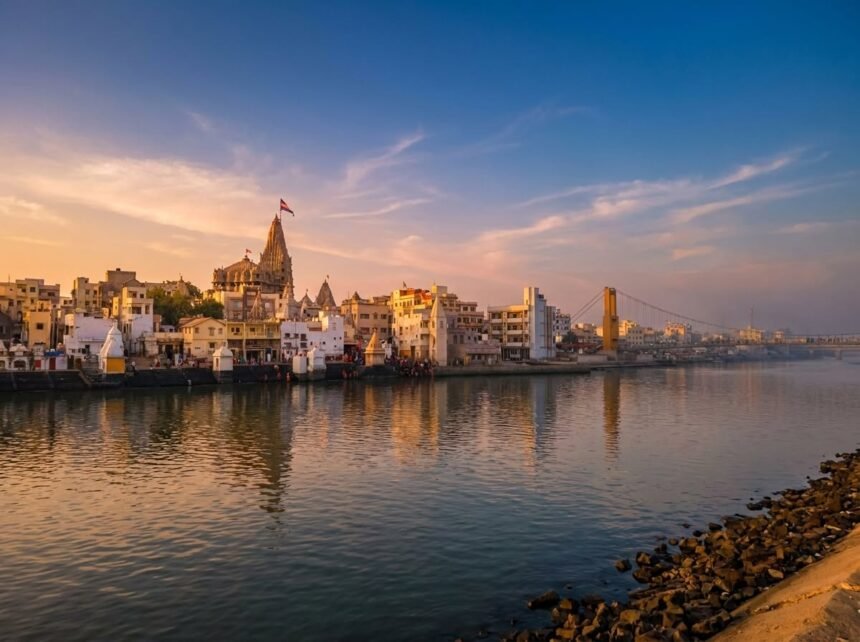
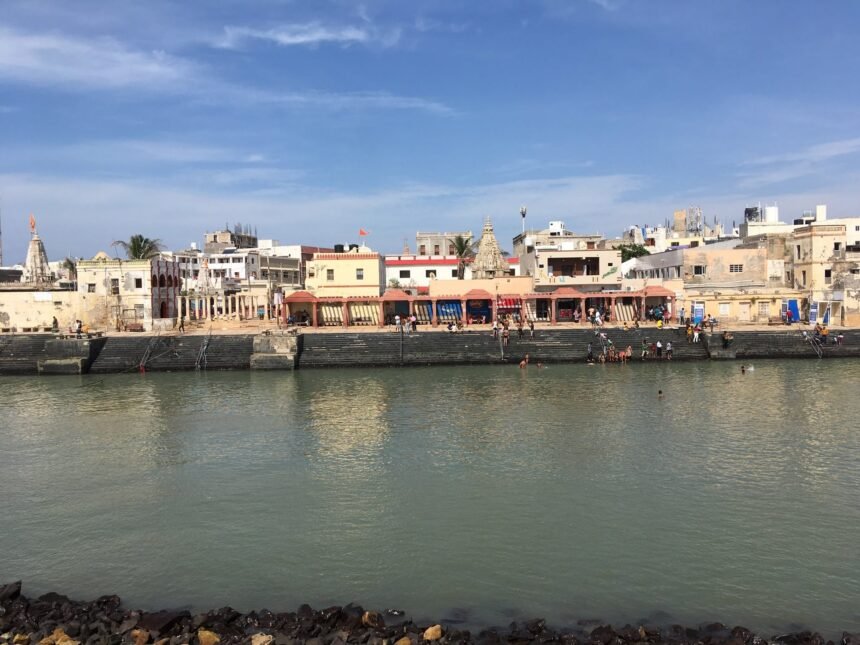
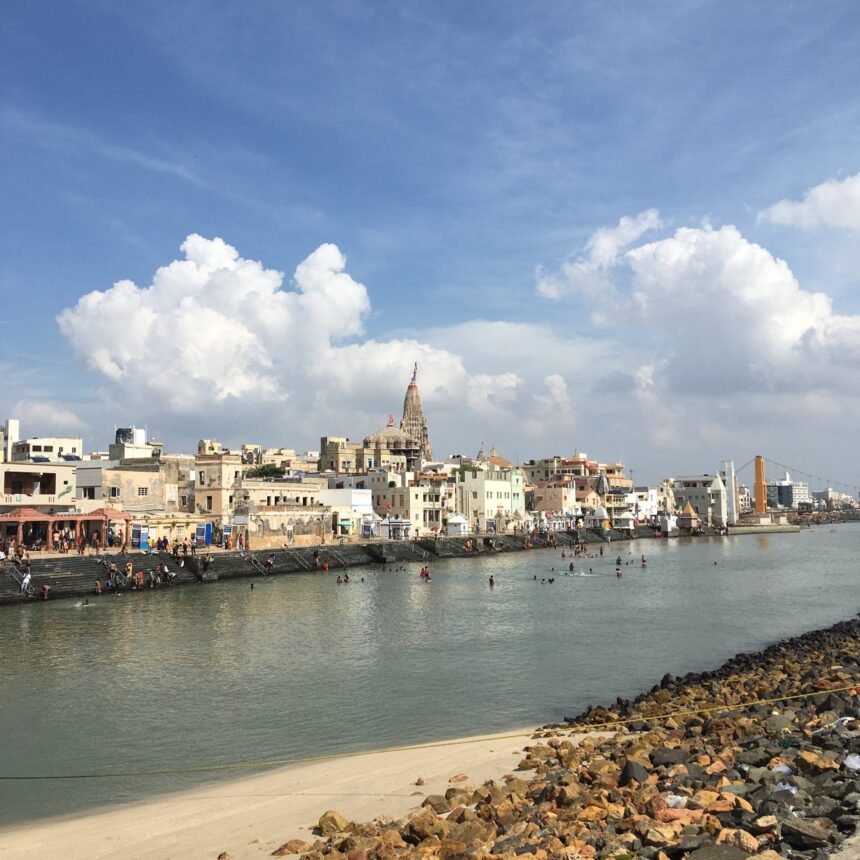
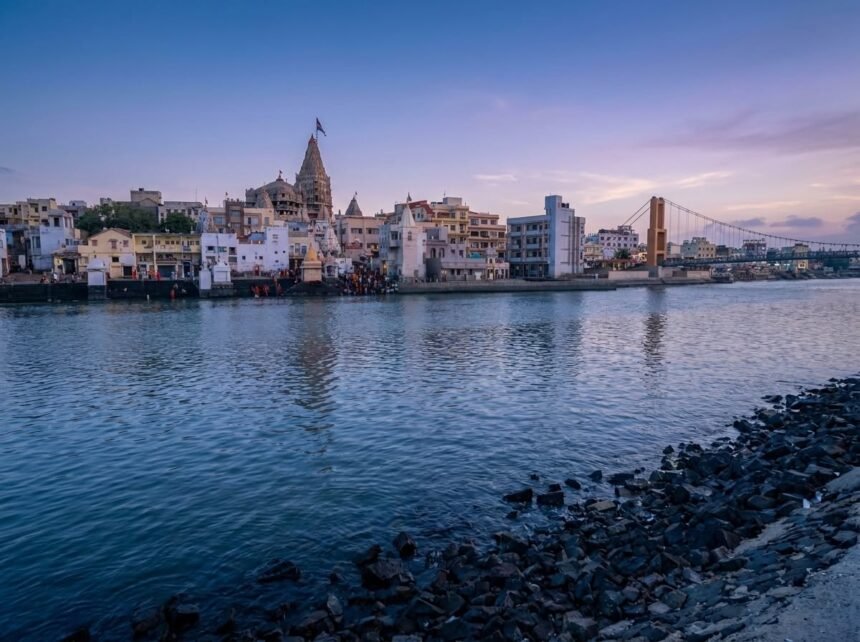
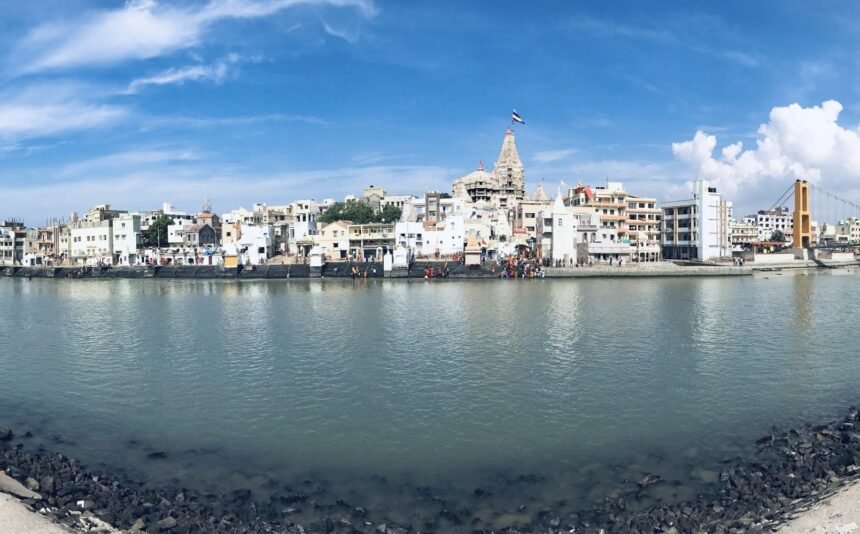
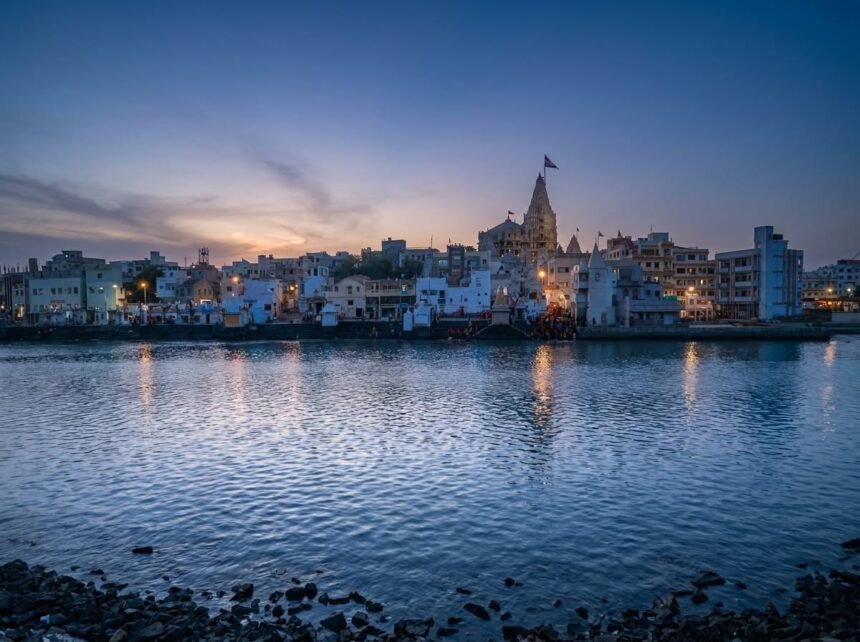
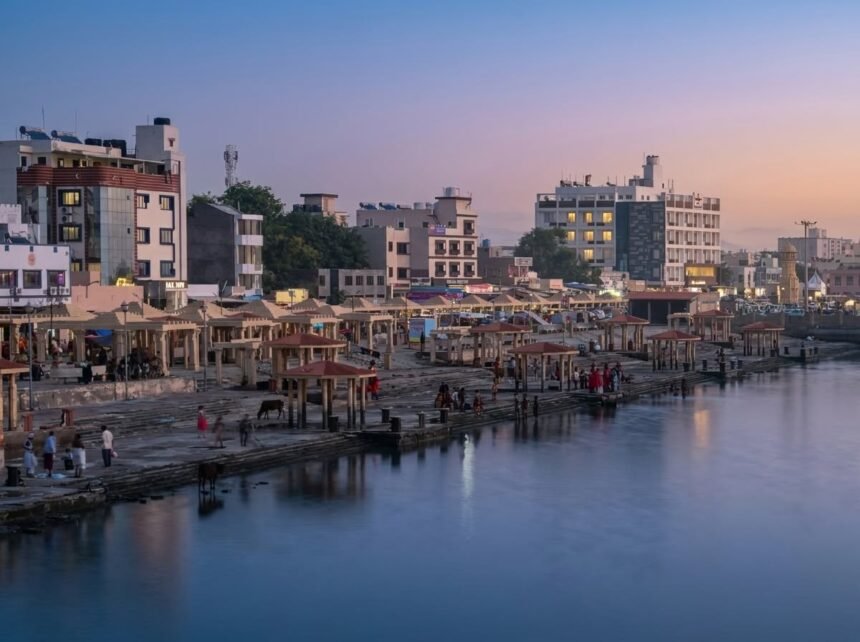
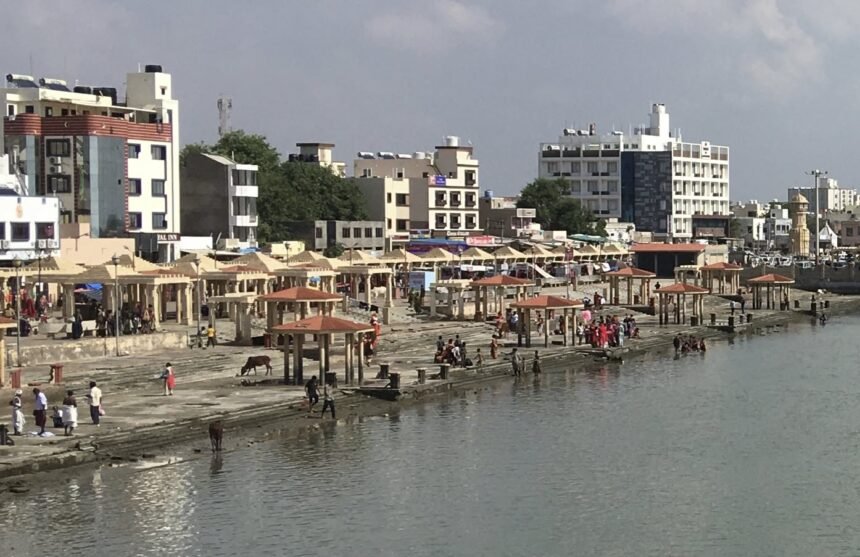
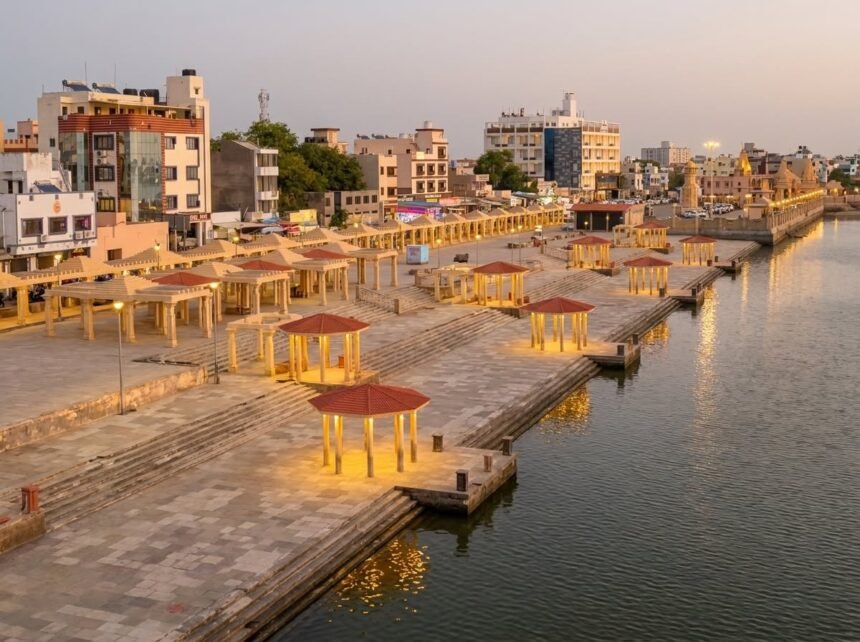
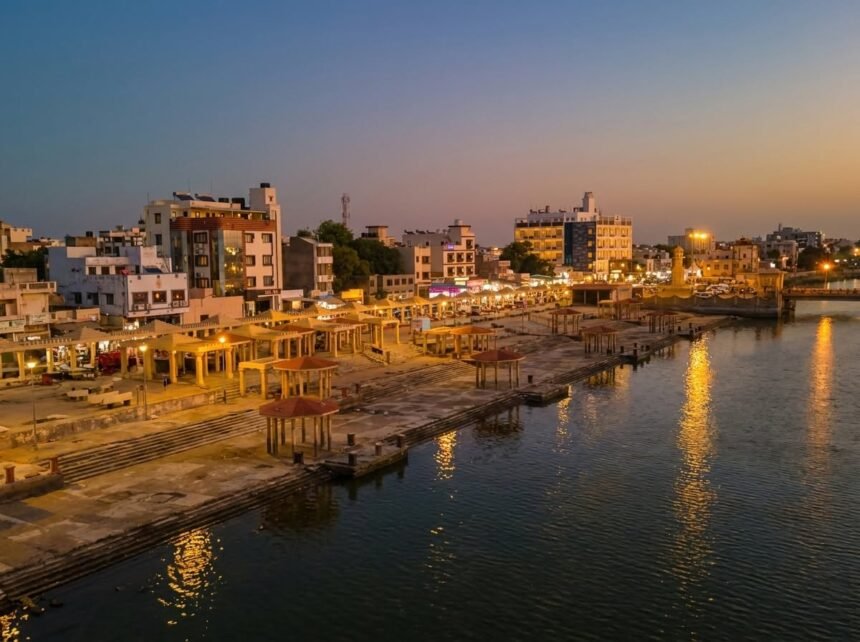
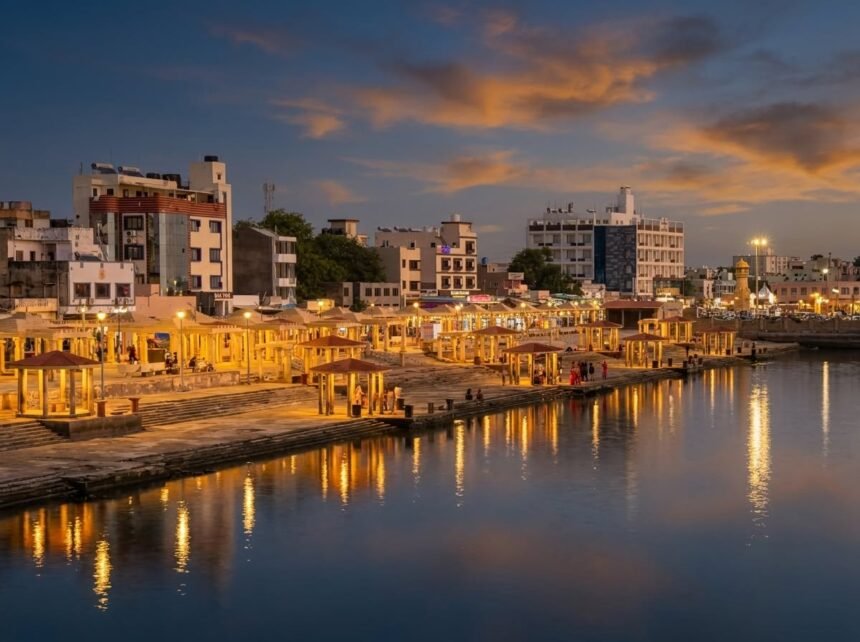
Gomti Ghat is structured as a complex ritual landscape designed to facilitate mass pilgrimage while maintaining strict theological protocols. The ghat spans the waterfront, featuring a succession of stepped embankments, shrines, and sacred pools that dictate the pilgrim’s physical and spiritual journey, serving as a buffer zone between the secular town and the divine sanctum.
The 56 Sacred Kunds
Embedded within the stone infrastructure of Gomti Ghat are 56 kunds (sacred bathing tanks). According to Vaishnava tradition, these kunds were commissioned by Queen Rukmini herself to provide sanctified, safe bathing facilities for the vast numbers of pilgrims arriving at her husband’s capital. The number 56 mirrors the 56 steps of the Swarg Dwar and refers back to the 56 legendary original ghats of the ancient Dwaravati mentioned in the Bhagavata Purana.
Each kund is dedicated to a specific deity, avatar, or sacred event, effectively forming a microcosm of the Hindu pantheon along the riverbank. The ritual of sequential bathing across these kunds is considered an act of supreme spiritual merit, designed to systematically strip away karmic impurities. The engineering of the tanks is notable; they are designed to capture the tidal influx of the Gomti River, ensuring that the sacred waters are continuously refreshed by the natural, rhythmic mechanics of the sea. Small shrines dot the perimeters of these kunds, housing deities such as Lord Shiva, Lord Rama, Saraswati, and Lakshmi.
Sudama Setu and the Panchanada Tirtha
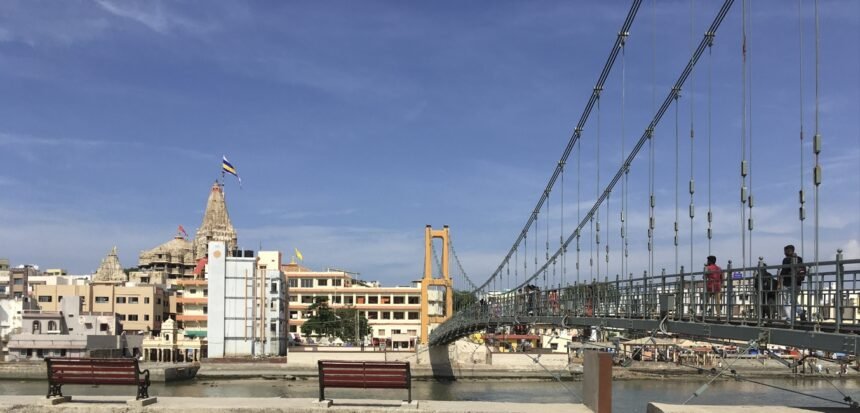
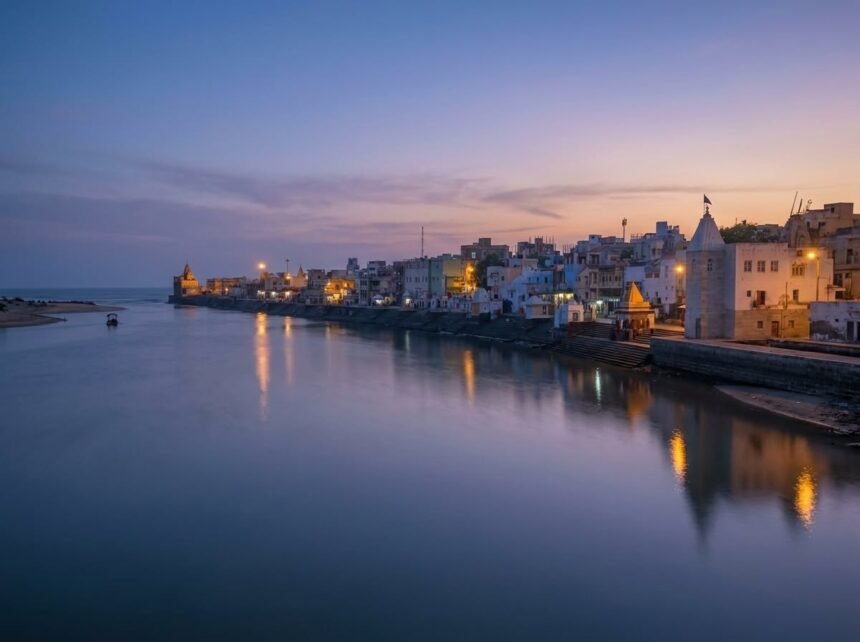
Connecting the main ghat to the southeastern bank (Panchkui Island) is the Sudama Setu, a pedestrian suspension bridge inaugurated in 2016. The bridge is named after Krishna’s impoverished but fiercely devoted childhood friend, Sudama, whose story of grace and friendship is a cornerstone of the Bhagavata Purana. From the elevated vantage point of this bridge, the panoramic layout of the 56 kunds, the tidal confluence of the river and the sea, and the towering Shikhara of the Dwarkadhish Temple can be viewed in their entirety, particularly striking during the golden hour of sunrise or sunset.
Crossing the Sudama Setu brings pilgrims to the Panchanada Tirtha (Panchkui), a tranquil site featuring five sweet-water wells directly associated with the five Pandava brothers of the Mahabharata. Local tradition asserts that the Pandavas meditated at this site, alongside five revered rishis, creating a rare geographical convergence of Krishna and Pandava narratives within the city limits. Although closed for structural safety renovations beginning in October 2022 with a targeted reopening in 2025, the bridge remains a critical piece of modern infrastructure linking these ancient sacred sites.
Samudra Narayana and Bhadkeshwar Mahadev
At the absolute terminal point of the ghat, where the river’s boundary dissolves completely into the Arabian Sea, stands the Samudra Narayana Temple. Dedicated to Lord Vishnu as the master of the oceans, this shrine marks the culmination of the Gomti Ghat ritual sequence. The temple complex houses a sacred tank where ceremonial sacrifices are performed, and it enshrines idols of Goddess Gomti, Samudra Deva (the Sea God), and Mira Bai, the 16th-century mystic poetess who, according to legend, physically dissolved into the idol of Dwarkadhish.
A short walk along the coastal promenade from the ghat leads to the Bhadkeshwar Mahadev Temple, a dramatic structure built on a rocky outcropping in the sea. Accessible only during low tide, the temple becomes completely surrounded by the ocean during high tide. The presence of this prominent Shiva temple on the coast of a definitively Vaishnava city highlights the syncretic nature of Hindu worship, where the forces of preservation (Vishnu) and dissolution (Shiva) share the exact same tidal ecosystem.
Ritual Architecture and Observances at Gomti Ghat
The spiritual economy of Dwarka is heavily dependent on the ritual activities conducted along Gomti Ghat. The waterfront operates as an expansive open-air sanctuary where personal devotion, strict ancestral obligations, and communal worship intersect seamlessly.
The Purification Rite: Holy Snan
The foundational ritual of any Dwarka pilgrimage is the Holy Snan (sacred bath) at Gomti Ghat. Theologically, a devotee cannot approach the inner sanctum of the Dwarkadhish Temple to gaze upon the deity without first achieving physical and energetic purification. Pilgrims typically arrive at the ghat in the early morning hours, descending the 56 steps to the water’s edge. Because the Gomti is a tidal estuary, the physical experience of the bath is dictated by the lunar cycle and the Arabian Sea’s tides. Bathing at the exact point of the Sangam (confluence) is believed to harness the dual spiritual energies of the descending river and the primordial ocean, washing away mortal sins and untangling karmic knots accumulated over lifetimes.
Pind Daan and Ancestral Veneration
Gomti Ghat serves as one of India’s premier destinations for Pind Daan the rigorous, highly codified Hindu ritual of offering sustenance to departed ancestors to secure their release from purgatorial states and ensure their transition to moksha (liberation).
The theological imperative for Pind Daan is deeply rooted in the Mahabharata and the concept of Pitru Rina (a binding cosmic debt to one’s ancestors). In Vedic cosmology, humans are born with this unpayable debt, which can only be managed through continuous ritual offerings. The Mahabharata underscores this through the narrative of Karna. Despite his legendary earthly generosity, Karna arrived in heaven only to be served gold and jewels instead of food because he had failed to perform ancestral rites for his unrecognized lineage. Indra granted him a 15-day return to earth (which became the Pitrupaksha period) to offer food to his ancestors. Similarly, following the war, Yudhishthira performed the Pind Daan for Bhishma, establishing the precedent that devoted relatives must fulfill this obligation regardless of direct biological sonhood.
The connection to the Mahabharata is further solidified by Dwarka’s geographic relationship to Pindara (Pandu Pindara). According to regional epics, after the Kurukshetra war, the Pandavas were instructed to identify 108 iron pinds at Pindara and perform pitru tarpan (ancestral rites) at the Trayambkeshwar Kund to absolve themselves of the sins of fratricide.
At Gomti Ghat, Teerth Purohits (specialized pilgrimage priests) guide devotees through a meticulous 10-step procedure lasting up to four hours. The Pinda itself is a ball composed of cooked rice (Pakvanna) or barley flour (Sattu), mixed with black sesame seeds (Kala Til), ghee, honey, and milk.
| Ritual Step | Action and Significance in Pind Daan |
| 1. Vedi Nirman | Preparing the altar using Kusha grass to create a protective barrier and seating area. |
| 2. Rekha Karan | Drawing a sacred line and chanting mantras to ward off inauspicious entities (Asuras). |
| 3. Avanejana | Purifying the base ground with water before the placement of the offerings. |
| 4. Kusha Astaran | Laying the sacred grass seat upon which the ancestral spirits are invited to rest. |
| 5. Pinda Daan | The core offering. Typically, three Pindas are offered (for the father, grandfather, and great-grandfather) to provide subtle nourishment. |
The rituals strictly forbid the use of iron vessels, as they are considered highly inauspicious for Pitru rites. Instead, priests mandate the use of silver vessels which the Manusmriti states are most pleasing to the ancestors or natural Palash leaf bowls and earthen pots.
Sandhya Aarti and Deepdaan
As the sun begins to set, the chaotic daytime energy of the ghat transitions into the highly choreographed Sandhya Aarti (evening worship). Timing for the Aarti shifts with the seasons beginning at approximately 6:00 PM in the winter and closer to 7:00 PM in the summer.
Priests array themselves along the stone steps, wielding large, multi-tiered brass lamps (aarti thalis) filled with ghee-soaked wicks. The ritual commences with the resonant blowing of conch shells and the ringing of temple bells, creating an acoustic landscape that drifts across the tidal waters. The visual spectacle peaks during the Deepdaan ceremony. Devotees purchase small clay lamps (diyas), light them, and set them afloat on the Gomti River. Hundreds of these flickering flames drift out toward the dark expanse of the Arabian Sea on the outgoing tide, carrying the prayers, ancestral wishes, and spiritual intentions of the pilgrims. This daily act of sending light into the ocean perfectly encapsulates the metaphysical philosophy of Dwarka: the individual soul (the river/diya) gracefully merging into the infinite cosmic consciousness (the sea).
Annual Festivals and Temporal Rhythms
The ritual life of Gomti Ghat and the Dwarkadhish Temple operates on a grand temporal scale, marked by massive annual festivals that draw hundreds of thousands of devotees, temporarily transforming the urban, acoustic, and hydrological landscape of the city. Furthermore, the daily rhythm of the temple itself reflects a royal court, acknowledging Krishna’s status as the reigning king of Dwarka.
The Dhwaja Arohan: Rhythms of Sovereignty
The assertion of divine sovereignty over the city is continuously reaffirmed through the Dhwaja Arohan ritual. Five times daily three times in the morning and twice in the evening the temple flag is ceremonially replaced atop the Shikhara. The massive flag, measuring 52 yards (symbolically representing 27 nakshatras, 12 zodiac signs, 9 planets, and 4 cardinal directions), is hoisted by specialized temple personnel. Sponsored by devotee families who endure waitlists that can stretch for years, the changing of the flag is accompanied by elaborate pujas and the feeding of local Brahmins, serving as a highly visible marker of devotion that can be seen from miles away across the barren plains. Inside the temple, the deity’s day is divided by six specific aartis: Mangala (awakening), Shringar (adornment), Gwal (preparing for the cowshed), Rajbhog (the royal midday feast), Sandhya (evening), and Shayan (resting).
Janmashtami: The Midnight Abhishek
The most spectacular event in the Dwarka calendar is Janmashtami, celebrating the birth of Lord Krishna in the month of Bhadrapada (August/September). As the historic capital of Krishna’s adulthood, Dwarka attracts over 500,000 pilgrims for this multi-day event.
The festivities follow the Nitya Kram (daily routine) of Krishna, beginning with the Mangla Aarti and the offering of Banta Bhog (milk products) to the deity, who is later given a rare holy bath. The Gomti riverbank transforms into the Dwarka Utsav, a sprawling cultural fair featuring continuous bhajans, Raas Leela folk dances depicting Krishna’s divine play, and the Makhan Handi event, where youth form towering human pyramids to break suspended pots of butter.
The climax occurs inside the Jagat Mandir precisely at midnight. As the clock strikes 12:00 AM, the massive crowd chants “Jai Dwarkadhish,” and the priests commence the Abhishek (ritual bathing) of the main idol. The deity is bathed in Panchamrit a sacred mixture of milk, curd, honey, ghee, and sugar while Rigvedic mantras are chanted in deep intonation and conch shells are blown, echoing out over the darkened Arabian Sea. The idol is subsequently adorned in yellow Pitambar robes and priceless gold, diamond, and topaz jewelry, signaling the arrival of the divine king to his people. Local families break their day-long fasts with the panchamrit and customary sweets like poha and dhaniya-panjiri.
Diwali, Annakut, and Seasonal Festivities
During Diwali, the festival of lights, the synergy between the Dwarkadhish Temple and Gomti Ghat reaches an aesthetic zenith. The ghat’s 56 steps are illuminated with thousands of oil lamps, and the offshore Bhadkeshwar Mahadev Temple appears to float in a sea of light during high tide, while the main temple’s spire is outlined entirely in lights.
The day following Diwali marks the Annakut (mountain of food) festival. Originating from the myth of Krishna lifting Govardhan Hill to protect the villagers of Vrindavan from the wrath of the rain god Indra, the priests of Dwarka arrange an astonishing tableau of hundreds of food items. Elaborate rows of cooked rice, flatbreads, sabzis, sweets, and seasonal fruits are presented before the deity, symbolically recreating the mountain, before being distributed to the masses as prasad.
Other major festivals fundamentally alter the town’s atmosphere. During the Braj-style Holi celebrations, starting from Phulera Dooj, the temple courtyards are filled with flower petals and subsequently with vast clouds of colored gulal powder, concluding with Rang Panchami. On the 24 annual Ekadashi days, devotees observe strict fasts (abstaining from all grains) and converge on Gomti Ghat for ritual baths that are believed to yield exponentially higher spiritual merit on these specific lunar phases. During Navratri, the banks of the Gomti resonate for nine nights with the rhythmic beats of Garba and Dandiya dances.
The Gomti Chakra: Biological Reality, Astrological Symbolism, and Commerce
A unique defining feature of the Gomti River’s specific tidal ecosystem and Dwarka’s overarching spiritual commerce is the Gomti Chakra. Found naturally in the riverbed and the adjacent shallow coastal waters, these small, disc-like objects are highly sought after by pilgrims, tourists, and practitioners of Vedic astrology and Vastu Shastra.
Biological Classification and Morphology
Biologically, the Gomti Chakra is not a stone, fossil, or standard seashell, but rather an operculum a hard, calcareous, trap-door-like anatomical structure attached to the upper surface of the foot of specific marine gastropod mollusks (sea snails). Taxonomically, these snails belong primarily to the family Turbinidae (turban snails), encompassing genera such as Turbo or Lunella.
When the snail retracts its soft body into its shell to protect itself from predators or the threat of desiccation during low tide, the operculum completely seals the aperture, acting as an armored defensive louver. After the organism dies and the shell eventually degrades or washes away, these durable, heavily calcified disc-shaped opercula are left behind in the sediment. Over thousands of years, the river and tidal currents smooth them into their distinctive shape: a flat, white or off-white side exhibiting a prominent, naturally occurring Fibonacci-like spiral pattern, and a smooth, slightly darker domed reverse side.
| Characteristic | Description in relation to Gomti Chakra |
| Scientific Classification | Operculum of marine gastropods, family Turbinidae. |
| Origin / Habitat | Found predominantly in the Gomti River and surrounding Arabian Sea coast near Dwarka, Gujarat. |
| Morphology | Calcareous disc; flat side features a natural spiral; reverse is a smooth dome. |
| Alternate Biological Names | Cat’s eye shell, Cow’s eye shell (Note: highly related to the “Shiva Eye” shell of Lunella smaragda). |
Metaphysical Significance and Ritual Utility
In Hindu iconography, the spiral pattern on the flat side of the operculum bears a striking, inescapable resemblance to the Sudarshan Chakra, the divine, spinning discus weapon wielded by Lord Vishnu (and his avatar, Krishna). Consequently, the Gomti Chakra is worshipped as a direct, physical manifestation of divine protection left upon the earth.
Furthermore, the name “Gomti” traces its etymology to the Sanskrit root Gomatī, meaning “possessing cows” or “rich in cattle” a historic pastoral metaphor for boundless wealth, agricultural prosperity, and sustenance. As such, the object is intimately linked to Goddess Mahalakshmi, the deity of wealth and consort of Vishnu.
The Gomti Chakra holds multifaceted utilities in contemporary Hindu spiritual practice, driving a massive local handicraft and religious artifact economy along the ghats:
- Vastu Shastra and Structural Protection: In the ancient Indian science of architecture and spatial geometry (Vastu), the Gomti Chakra is deployed to neutralize spatial defects (Dikh Dosha). It is a common, highly regarded practice to bury 11 Gomti Chakras in the foundation of a new building to ensure longevity, peace, and prosperity for the residents. Similarly, they are wrapped in yellow or red cloth and hung above the main entrances of shops and homes to block negative energy and attract commercial success.
- Astrological Remedies (Naag Dosha): The coiled, spiral pattern is also deeply associated with the Nagas (divine serpents). In Vedic astrology, individuals suffering from Naag Dosha or Sarpa Dosha malefic alignments of the lunar nodes, Rahu (the snake’s head) and Ketu (the snake’s tail) are advised to keep or wear Gomti Chakras to pacify these serpentine energies and clear blocked life pathways.
- Talismanic Protection: It is widely used as a protective talisman, particularly for children, to guard against illness and the “evil eye” (Buri Nazar). A traditional folk remedy involves rotating 11 purified Gomti Chakras over an afflicted person’s head seven times to absorb and dispel malicious psychic energy.
- Diwali and Dhanteras Pujas: Because of its indelible link to Goddess Lakshmi, the Gomti Chakra is a central component of wealth-activation rituals during the Diwali festival. They are placed in cash lockers, business safes, and household altars to ensure that the Goddess of Wealth remains permanently in residence, opening blocked channels of financial flow.
Despite modern commercialization and the spread of pseudoscientific myths such as the unfounded, widely circulated rumor that the stones are “alive” and will literally reproduce if kept hidden in a container of flour the Gomti Chakra remains a profound example of how a biological artifact from a specific micro-ecology is elevated into a potent symbol of cosmic law, divine grace, and everyday hope.
Looking back on the horizon
Gomti Ghat is far more than a physical stone embankment leading down to the Arabian Sea; it is the vital, pulsating artery of Dwarka’s spiritual anatomy. An exhaustive analysis of the ghat reveals a highly complex landscape where geological history, mythological antiquity, and rigorous ritual protocols are inextricably bound together.
The marine archaeological evidence validating the ancient submersion of the region provides a fascinating scientific substrate to the Mahabharata’s poetic descriptions of a lost golden city. Yet, it is the living theology of the site that sustains it. From the 56 mythological steps representing a fallen clan, to the intricately designed 56 kunds serving as a purification threshold, the architecture of the ghat is explicitly designed to transition the pilgrim from the mundane, secular world into the divine, royal presence of the Dwarkadhish Temple.
Through the performance of Pind Daan, the ghat acts as a cosmic clearinghouse for generational debt, linking the living, the dead, and the divine in a continuous cycle of obligation and release. Through the sensory theater of the evening Sandhya Aarti and the floating of diyas, it provides a daily framework for personal surrender to the vastness of the ocean. Finally, in the humble form of the Gomti Chakra a marine snail’s operculum transformed by faith into the spinning weapon of a god Gomti Ghat demonstrates Hinduism’s unique capacity to completely consecrate the natural world. In Dwarka, the meeting of the river and the sea is not merely an estuarine phenomenon, but the eternal, physical gateway through which the mortal soul approaches liberation.